
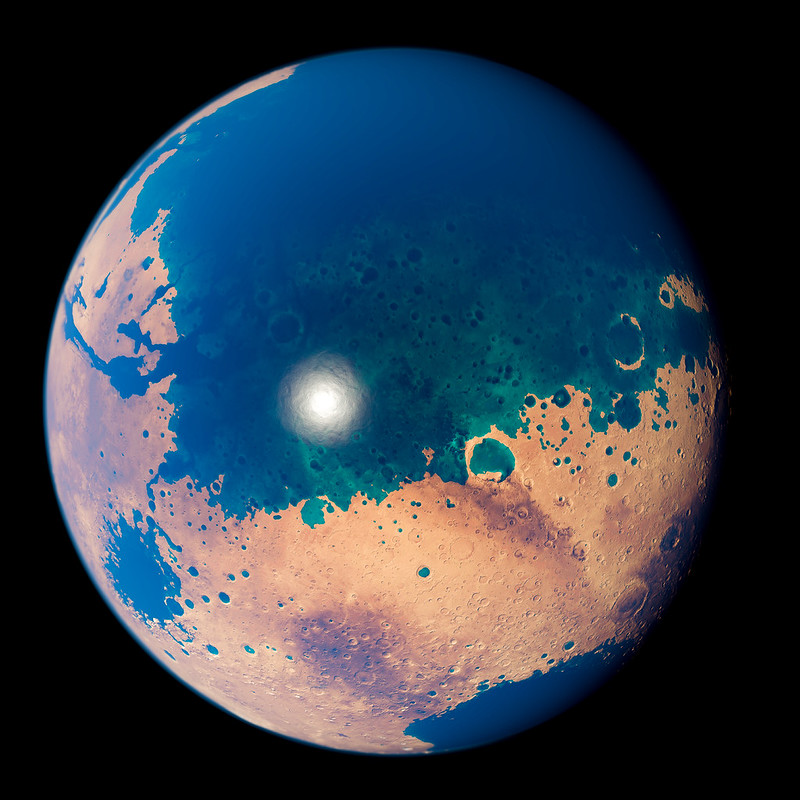

Most people think of Mars as a big red dustball, but researchers recently found Martian mineral deposits suggesting it was once warm and humid. The team used the Compact Reconnaissance Imaging Spectrometer aboard NASA’s Mars Reconnaissance Orbiter to analyze specific wavelengths of visible and near-infrared light from minerals on Mars’s surface to determine their chemical composition from afar.
Past researchers identified layered silicate minerals, called clays, across the Martian surface. Clays form when water interacts with rock, and record the amounts and chemical compositions of the waters that formed them. As water interacted with Martian surface rocks, it picked up more mobile elements like magnesium and iron and carried them to lower depths in the Martian soils, while less mobile elements like aluminum stayed in place. This process, called leaching, created 2 distinct layers of clays in the Martian rocks.
Scientists have proposed 2 main hypotheses for how these layered clays formed on Mars. The first is that they formed through underwater leaching in pools or lakes sometime in Mars’ past. The second is that they formed across the Martian surface, where a widespread humid environment provided the moisture needed to leach them.
To evaluate these hypotheses, a team led by researchers at Purdue University recently estimated the “true” thicknesses of Martian clay layers with a method scientists had previously only used on Earth. Rock layers containing clays can become tilted, making them appear thicker or thinner than they actually are. To address this discrepancy, the team used the High Resolution Imaging Science Experiment (HiRISE) tool on the Mars Reconnaissance Orbiter to create high-resolution elevation maps of the Martian surface. Then they combined these maps with surface composition data from the Compact Reconnaissance Imaging Spectrometer to create 3D composition maps.
Using the 3D composition maps, the researchers found where each clay layer was exposed at the surface and traced it underground to estimate an angle of tilt. They then used trigonometry to calculate the true thicknesses of each clay layer. They analysed 46 regions across the Martian surface, and found that the combined thickness of both clay layers was around 20 to 680 feet (6 to 200 meters), with an average of about 190 feet (60 meters). That’s a maximum thickness as high as a 60-story building!
Next, the researchers tested the extent of the clay deposits in a large ancient Martian valley known as the Mawrth Vallis Region. They focused on this region because it had large elevation changes, and scientists in the past had already collected high-resolution chemical composition and elevation data there.
They explained that if the clay layers were restricted to the lowest parts of the valley where water once existed, and had changing thicknesses and boundaries between layers, this would provide strong evidence in favor of the “underwater leaching” hypothesis. In contrast, if the clay layers were more widespread, with consistent layer boundaries and thicknesses, this would provide strong evidence of a humid surface environment, in favor of the “surface leaching” hypothesis.
The researchers found that the clay layers extended beyond the lowest parts of the valley and had consistent layer boundaries across more than half a mile (about a kilometer) of elevation change. Thus, they concluded that the clay layers formed by surface leaching in a humid environment.
These findings conflict with climate models of early Mars, which generally suggest that the Martian surface rarely got above freezing temperatures. To address this discrepancy, the team proposed that these deposits could have formed over a long period of time rather than in a consistently warm and wet environment. If the surface was frozen most of the time, but got above freezing in short bursts, these clay deposits could still have formed, just over a much longer time period. In this case, the Mars climate models and the researchers’ findings would agree.
The researchers acknowledged that their study has some limitations, particularly regarding the sparse sample locations. Though they found strong evidence for a widespread humid environment on early Mars, more in-depth studies of locations like Mawrth Vallis could better constrain the specific surface environmental conditions under which these clays formed and potentially reconcile their data with Martian climate models.
