

The spots on a leopard, the stripes on a zebra, and the mask on a raccoon are all types of coloration in mammal fur, referred to as pelage. Scientists have struggled for a long time to understand how these colorations evolved. A team of researchers recently discovered how to reconstruct the colors of ancient mammal fur using cell structures that contain the chemical pigment melanin, known as melanosomes. They hope to use this understanding of ancient mammal pelage to determine how they lived and what their environments were like.
To decipher the color of ancient mammal fur, the researchers constructed a statistical computer model to predict their fur colors based on the shape of their melanosomes. First, they needed to understand how the shapes of melanosomes control fur color in modern mammals. To measure the length and width of the modern melanosomes, the scientists used a beam of electrons like a flashlight to map them in great detail, a technique called scanning electron microscopy.
They measured the length and width of 2,615 melanosomes from the fur of 116 different living mammal species, including a Red Panda, a German Shepard, and one or more species of most types in the mammalian classification. Then they recorded the wavelengths of light reflected off each melanosome using a microspectrophotometer. These wavelengths represented the exact color of hair from each melanosome they measured. This means they now had a quantitative measurement of the color of each hair to compare with its corresponding melanosome length and width.
When they examined their data, the researchers found that spherical melanosomes produced brighter fur colors, like reds and oranges, while elongated melanosomes produced darker fur colors, like browns and grays. The researchers plotted the microspectrophotometric measurements for each melanosome as a graph showing how much light it absorbed across each possible wavelength, creating reflectance curves. Based on these data, the researchers used computer software to create a statistical model that could predict reflectance curves, and therefore color, from melanosome shape alone.
Once the researchers created a model, they needed to find fossilized mammal melanosomes to predict their fur color. Mammal fossils are rare, and pieces of cells are only preserved in the most immaculate fossil deposits. In fact, these researchers only found 6 fossils of this caliber, from Mesozoic rocks deposited around 250 million years ago, soon after mammals evolved.
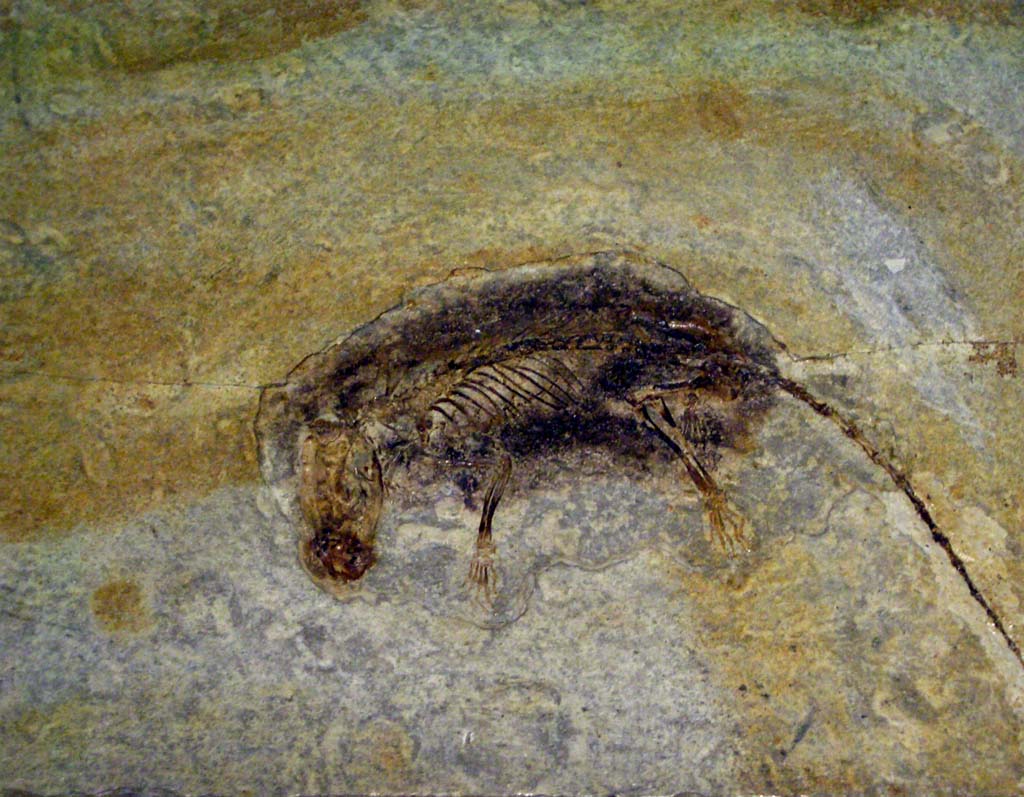
The fossils came from 2 world-renowned deposits in Northeastern China, the Yanliao and Jehol biotas. They selected 5 previously studied fossils from these locations, including 1 specimen of Megaconus mammaliaformis, 1 specimen of Vilevolodon diplomylos, 2 specimens from the group Docodonta, and 1 specimen from the group Eutheria. All of these animals were small, rodent-like mammals. The researchers also discovered a new species of tree-dwelling mammal, Arboroharamiya fuscus.
The scientists used scanning electron microscopy to measure a total of 2,159 fossilized melanosomes to refine their color predictions. The fossilized melanosomes were all slightly elongated spheres and had far fewer differences in shape than in modern mammals. The researchers used their model to predict reflectance curves based on the shapes of the fossil melanosomes to determine the ancient mammals’ colors. They found that all the extinct mammals they examined likely had dark brown fur without any color patterns.
Based on these findings, the researchers suggested that most, if not all, early mammals were nocturnal, like many dark-colored mammals today. They suggested that this nocturnal lifestyle probably helped them survive the meteorite impact that wiped out the dinosaurs 100 million years later. While dinosaurs were unable to survive in the post-impact wasteland, these smaller, dark-colored mammals were more resilient and thrived in the aftermath. As mammals filled the ecological roles left by the dinosaurs, they evolved new color patterns, some based solely on camouflage, and others on new factors, like sexual selection and visual communication.
The researchers concluded that their model can predict fossilized mammal colors and help determine how these ancient animals lived. Notably, their data suggest that mammals likely stayed small and nocturnal throughout the Mesozoic until the dinosaurs were gone. Future researchers could use similar methods to uncover exactly how mammals evolved the colors we see today. For example, studying mammals closer to the impact event could reveal if it took a long time to develop diverse fur patterns, or if they began before the dinosaurs’ demise. Ultimately, similar studies could help determine whether the extinction of dinosaurs was necessary for the rise of mammals.

