

Since the JWST began releasing data in 2022, this satellite telescope has helped astronomers detect chemicals in the atmospheres of exoplanets around other stars. It does so using a technique that detects different light patterns called transmission spectroscopy.
To perform transmission spectroscopy, JWST views a distant star system and waits for an exoplanet to pass between it and the host star, blocking some light. Some of these exoplanets are surrounded by a thin shell of atmospheric gases, and different gases block some but not all of the host star’s light. Astronomers can deduce some of the atmosphere’s contents by observing which wavelengths these gases block and comparing those results to the known behavior of chemicals on Earth.
Assessing exoplanet atmospheres not only helps scientists understand the diversity of these objects in more detail, but it could also potentially find evidence of complex chemistry created by life. While transmission spectroscopy can help identify some chemicals in an exoplanet’s atmosphere, it does not paint the full picture of what these atmospheres contain. For example, astronomers can’t easily determine the relative abundances of chemicals in these atmospheres, and the chemicals they can search for are limited by the wavelengths of light their telescope can detect.
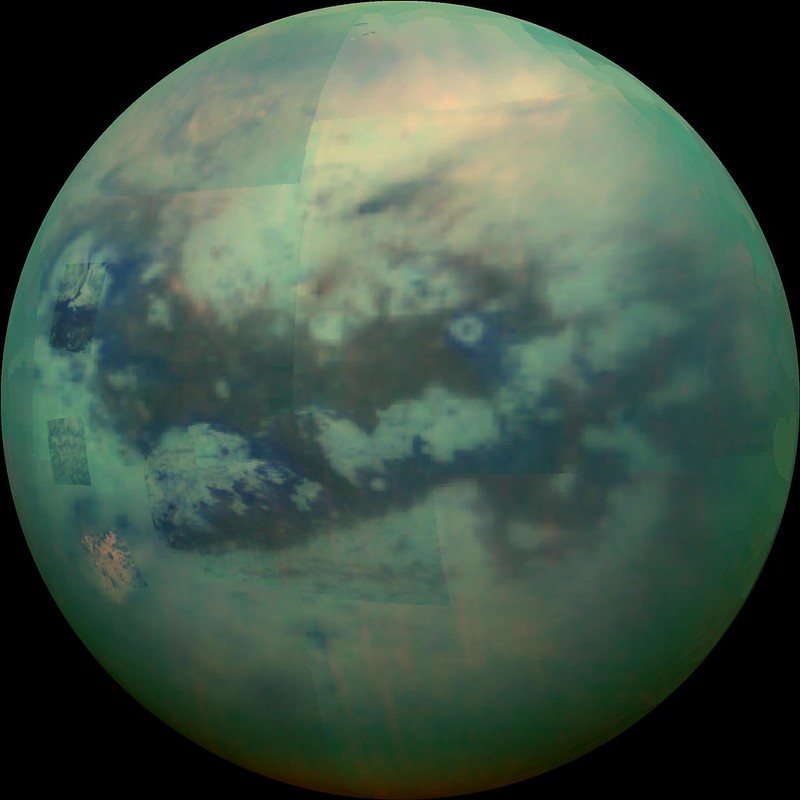
Recently, a team of American scientists tested how well the JWST could determine the chemistry of a hypothetical potentially habitable exoplanet with a complex surface and atmosphere using transmission spectroscopy. In this case, they used Saturn’s largest moon, Titan, as their reference point. Then they modeled what JWST would observe if the exoplanet TRAPPIST-1 h had surface and atmospheric properties similar to Titan and astronomers tried to take a transmission spectrum of it. The discrepancies between Titan’s known properties and this model would show how much JWST transmission spectroscopy flattens the real complexities of exoplanet atmospheres.
The team chose Titan because it has several traits that make it a prime target in the search for life in space. Titan may have liquid water beneath its icy surface. Above the ice, it has liquid seas consisting of the hydrocarbons methane and ethane. Titan has weather patterns in its hazy atmosphere, which is made up largely of nitrogen gas and methane. Astronomers studying TRAPPIST-1 h have found that it has a density similar to ocean worlds like Titan. The team used data from the Cassini spacecraft’s VIMS-IR instrument observations of Titan to build their model of an “exo-Titan’s” chemical features.
Next, the team employed the latest version of a program called Atmos to run the calculations related to the light and chemical reactions that would produce a Titan–like haze on their modeled version of TRAPPIST-1 h. They used 2 other programs, POSEIDON and rfast, to simulate the properties of the hazy TRAPPIST-1 h as JWST would detect them over several observations of this hypothetical exoplanet passing in front of its star.
They found that JWST’s transmission spectroscopy would generally produce accurate information about a hazy exo-Titan’s atmosphere. They claimed that astronomers using the telescope could correctly identify methane, propane, and carbon monoxide in the atmosphere and that the hydrocarbons formed a thick haze.
However, the researchers found that JWST would be unable to accurately determine the relative abundances of atmospheric gases. In fact, they suggested that without knowing the exact properties of this exo-Titan beforehand, a potential interpretation of their results would be that the hazy TRAPPIST-1 h’s atmosphere is 99.8% methane by volume, with only trace amounts of nitrogen gas. This deviates from the real Titan’s atmosphere, which is between 93% and 95% nitrogen gas.
The researchers explained that this issue stems from methane being a more active chemical than the relatively inert nitrogen gas. They suggested it could be addressed by pairing JWST with another telescope that can detect shorter wavelengths of light. Therefore, the team concluded that the Hubble Space Telescope or the proposed Habitable Worlds Observatory, which could search for chemicals JWST can’t, could help to more accurately gauge an exoplanet’s atmospheric composition and aid in the search for life.
