

Have you ever caught a whiff of rotten eggs at the edge of a marshy lake? If so, you were smelling sulfate-reducing bacteria hard at work. These microbes occupy underground habitats without oxygen, where they transform sulfate into hydrogen sulfide, the source of their recognizable stench. Sulfate-reducing bacteria can also remove metal ions from solutions, so scientists think they could help clean up acid mine drainage and heavy-metal pollution.
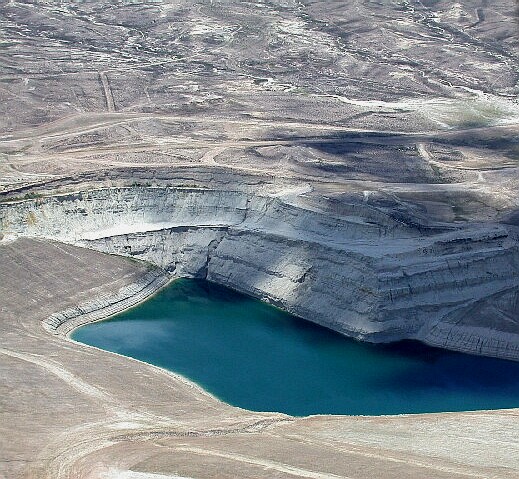
To harvest valuable metals like uranium, miners inject acidic fluid—commonly sulfate-containing sulfuric acid—underground to dissolve surrounding rock and flush out the target metals. However, this method releases other metals from the rock, which can contaminate aquifers. The increased acidity and heavy metals can also linger long after mining has ceased, threatening humans and the environment. To correct these toxic effects, researchers have focused their cleanup efforts on reducing acidity and removing radioactive uranium from groundwater.
Sulfate-reducing bacteria win in both categories—they remove sulfate from the environment, which reduces acidity, and they fix uranium and other toxic metals into stable forms. In laboratory experiments, scientists have found that these bacteria can transform dissolved uranium into stable solid, or insoluble, forms by adding electrons. Uranium also binds to sulfide minerals produced as byproducts by these cells. However, geoscientists didn’t know how effectively the microbes carry out these reactions under highly acidic conditions or in natural groundwater flow.
Researchers from China set out to better understand how sulfate-reducing bacteria fare under conditions that mimic an underground aquifer. Groundwater moves through pores in rocks at a constant velocity, or flow rate. They hypothesized that this natural flow could disrupt microbial communities by poisoning them with oxygen or physically washing them away.
To test this, the researchers collected groundwater and rock samples from a decommissioned uranium mine in northwestern China and measured their pH and uranium abundances. Then they constructed a device called a horizontal flow reactor, which simulated groundwater movement by pumping the mine water through a 100-centimeter (about 4-foot) cylinder of mine rock. They installed 2 downstream ports along the reactor’s length to track how the groundwater changed as it moved through the device.
At the beginning of each experiment, they added 4 strains of sulfate-reducing bacteria that can bind uranium. Then they collected water samples from the downstream ports every 2 days for 40 days and analyzed their acidity and dissolved uranium contents.
First, the researchers adjusted the groundwater’s initial pH to 3.5, 4, and 4.5, and ran the reactor at the lowest flow rate. Under these conditions, they found that sulfate-reducing bacteria consistently reduced 90% or more of the dissolved uranium to its insoluble form, and they did it the fastest under less acidic, higher pH conditions closer to the bacteria’s preferred range.
Then they varied the flow rate through the reactor, from 0.5 milliliters per minute (mL/min) to 0.7 and 0.9 mL/min. They found that the bacteria depleted the most sulfate at a flow of 0.7 mL/min. They hypothesized that this medium flow rate was slow enough for the microbes to form stable colonies on the rock without washing away, but fast enough to deliver fresh nutrients and remove waste.
Finally, the researchers wanted to determine whether a sudden change in groundwater chemistry could release uranium back into the waters. They found that changing the groundwater to pH 2 for 7 days dissolved about 3% of the solid uranium created by the sulfate-reducing bacteria. Adding oxygen to the groundwater also released 0.5% of the stored uranium over that timescale.
The researchers concluded that sulfate-reducing bacteria can remove dissolved uranium from acidic aquifers quickly and efficiently. However, they emphasized that bioremediation is a long-term process that requires ongoing monitoring and stable conditions to work. As long as the sulfate-reducing bacteria stay happy, the uranium will stay locked away. So the next time you catch a whiff of rotten eggs, thank those stinky saviors—they might smell dirty, but they help keep our water supplies clean.
