
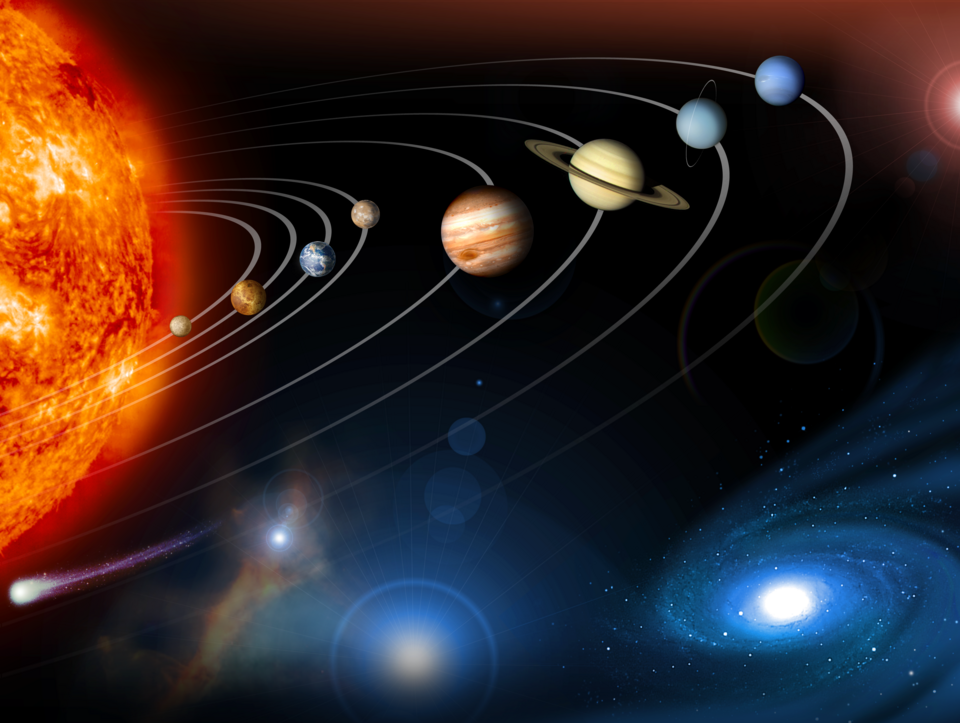

Around 4.6 billion years ago, an immense cloud of gas and dust in space collapsed in on itself. As it collapsed, gravity pulled most of the material toward several small points, one of which would eventually become our Sun. The other points formed other stars in what scientists call an open cluster.
During this early stage of the Sun’s life, it was surrounded by a swirling disk of leftover material aligned with its equator, known as a protoplanetary disk. Eventually, this disk condensed to form the planets that make up our solar system. This process normally results in a system with a star at its center, and the planets orbiting the plane of the star’s equator.
However, scientists have found that this scenario doesn’t quite hold for our solar system. The planets in our solar system orbit the Sun in a single plane offset from the Sun’s equator by approximately 6°. The fact that the planets are in the same orbital plane suggests that the protoplanetary disk model of solar system formation is correct, since the odds of the Sun capturing 8 rogue planets in this arrangement are astronomically low. So, what threw the planets in our solar system off-kilter?

The plane in which the solar system’s planets orbit the Sun is offset from the Sun’s equator by approximately 6°. Li simulated how the solar system tilted based on its 4 largest planets, from left to right: Neptune, Saturn, Jupiter, and Uranus. Illustration by Andrew Bizal.
To determine what caused the solar system to tilt, Daohai Li at Queen Mary University of London recently used the computer program NBODY6++ to model different versions of the open cluster from which the Sun came. In these simulations, he varied the number of stars in the cluster, from 500 to 2,000 to 8,000. He also varied the radius of the cluster, from 0.25 to 1 to 4 parsecs (8 to 30 to 100 trillion kilometers or 5 to 20 to 70 trillion miles). Finally, he varied the percentage of stars with a binary companion from 10% to 50% to 90%. Li assigned each star a randomly generated initial mass, starting position, and velocity, and simulated their interactions for 400 million years.
First, Li examined the simulations to identify stars with masses approximately equal to the Sun’s. From this group of solar-massed stars, Li found ones that left the cluster after 400 million years as a single star, after either forming alone or having lost a former companion star. He proposed that these stars were the most similar to the Sun and could thus host a simulated solar system.
Li then simulated the planets and their orbits as they would have formed on these potential host stars. To simplify this process, Li only simulated the 4 giant planets, Jupiter, Saturn, Uranus, and Neptune, which dominate planetary behavior in our solar system. He modeled these solar systems independently for 200 million years to ensure they would remain intact and used those that did for statistical analysis of the solar system’s past.
Overall, Li discovered 2 scenarios that could explain the solar system’s tilt. In the first, the primordial solar system was jostled by many distant neighboring stars in its cluster. This jostling tilts the planets’ orbits, but it does so randomly. Therefore, this scenario would make it unlikely for the planets to remain in the same orbital plane. It would also cause them to orbit the Sun faster and more chaotically than in our solar system.
In the second scenario, the Sun had a temporary companion star that it either formed with or briefly encountered before separating. When this occurred, the simulated planets’ orbits all tilted together. Stars that formed with a binary companion had a 10% chance of tilting their planets’ orbits by 6° or more, while stars that formed alone had a less than 0.1% chance.
Li concluded that the solar system could have tilted as a result of interactions between the Sun and a temporary companion star within its parent cluster. However, he acknowledged that the model strongly depends on how closely a star passes by the Sun, since the closer a star passes, the more it disturbs the solar system. Despite this uncertainty, it’s possible that somewhere in space is the Sun’s twin or former neighbor that we haven’t seen in eons, and that’s what made our solar system crooked!

