
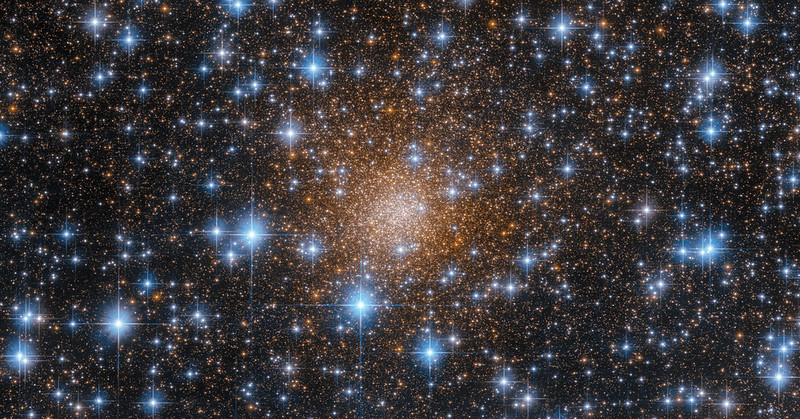

Stars are mostly made of 2 elements: hydrogen and helium. While this has always been the case, those 2 elements and lithium were the only elements in existence when the Big Bang occurred around 14 billion years ago. When the first stars exploded, they released those primordial elements, as well as heavier elements produced by nuclear fusion inside them.
Astronomers call all elements heavier than hydrogen and helium metals, a term chemists use quite differently. Subsequent generations of stars, including the Sun, formed in clouds of gas and dust enriched with these metals, such as carbon, oxygen, magnesium, and silicon. Scientists estimate that modern stars are 1% to 5% metal by mass.
Astronomers claim there is no solid evidence that stars contain exceptionally high amounts of metals, but some, called chemically peculiar stars, appear to. Astronomers study stars by looking at the patterns of light they emit, called spectra. Each element produces a unique light pattern, so astronomers can compare the light patterns in a star’s spectra to determine how much of each element is present, especially in the outer layers of the star. Researchers theorize that chemically peculiar stars don’t actually have more metals than average stars. Instead, they think that metals from their interiors diffuse to their outer layers more than in most stars.
A team of researchers from the American Association of Variable Star Observers and Masaryk University in Czechia recently observed 85 chemically peculiar stars to understand their behavior and better classify them. For their study, they first used the General Catalog of CP Stars, published in 2009 in Astronomy & Astrophysics, to identify targets across the 4 classes of these stars, labeled CP1 through CP4. CP1 stars have strong spectral patterns for iron and other heavy elements, CP2 stars have strong patterns for silicon, chromium, strontium, and europium, CP3 stars have strong patterns for mercury and manganese, and CP4 stars have either unusually weak or usually strong helium patterns.
The team compiled a list of 85 stars to observe, then used the BRIght Target Explorer (BRITE) Constellation to monitor changes in their brightness. The BRITE Constellation is a set of 5 satellites equipped with telescopes and cameras for either red or blue light. Using the BRITE Constellation, the team monitored each star for several days.
They found that 74 of these 85 chemically peculiar stars varied in brightness during their survey. They attributed this to the varied abundance of metals on their surfaces, which would form dark patches that go in and out of view from Earth’s perspective as the stars rotate. The team observed that 6 of these 74 stars appeared to change in brightness over multiple periods. They were surprised by this result because a star’s brightness wouldn’t vary over multiple periods if the changes were due to rotation. They compared their findings to data other scientists had collected from these stars with the Transiting Exoplanet Survey Satellite, or TESS, and found that all 6 stars had been misclassified as chemically peculiar stars.
The other 11 chemically peculiar stars appeared to show no periodic changes in their brightness, suggesting that they’re stationary. The team claimed that some CP1 and CP3 stars don’t rotate, but they identified cases in which CP2 and CP4 stars that ought to rotate appeared to be stationary. They suggested 2 potential reasons for this. One is that these CP2 and CP4 stars are misclassified, requiring more thorough analysis of their spectra to confirm their classifications. The other is that the stars rotate slowly, with rotational periods of 50 days or longer, which would be difficult to distinguish from those of totally stationary stars.
The team concluded that more astronomers should revisit the historical classifications of stars, especially as technology advances and more space-based telescopes become available. This strategy would allow future researchers to draw better data from research archives and catalogs. Additionally, they claimed that their method of pairing long-term monitoring via small satellites with TESS data is well-suited for refining classifications, identifying misclassified objects, and further exploring the structure and mechanics of chemically peculiar stars.
