
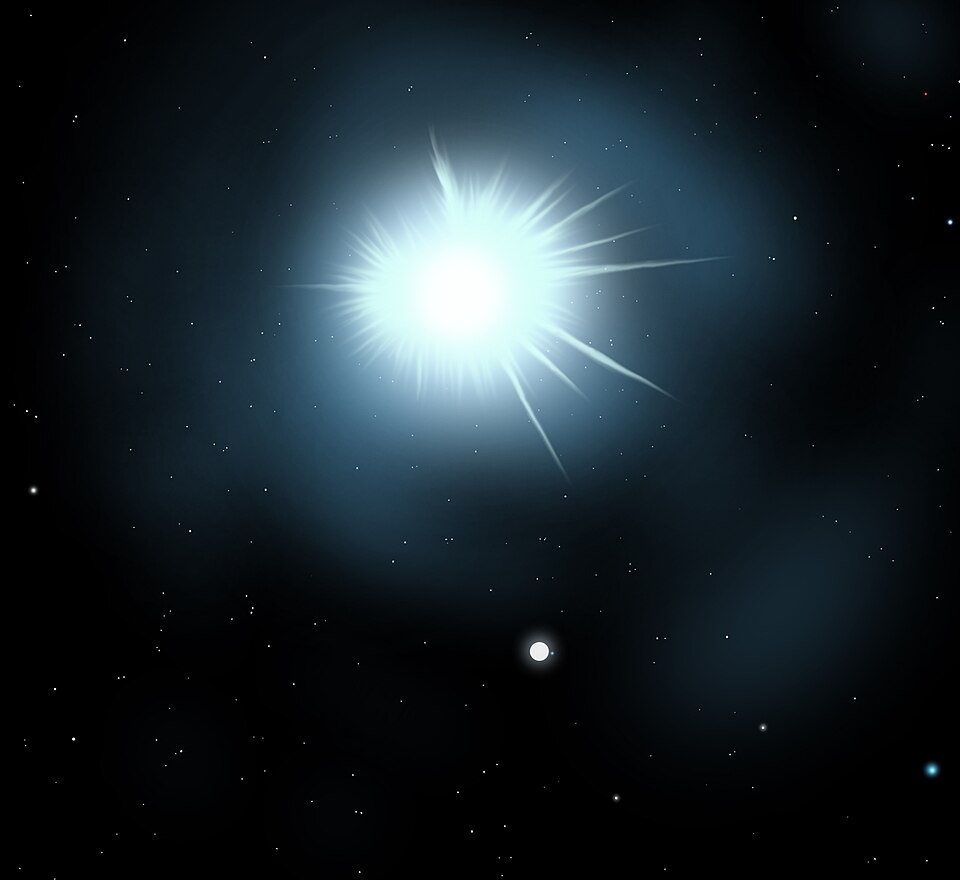

Carbon is the 4th most abundant element in the universe. It’s everywhere, from the air you breathe to the carbohydrates in your food to the petroleum in the Earth’s crust. Like most elements, carbon was not created by the Big Bang, but came from 2 different types of stars that fuse lighter elements together.
Massive stars at least 8 times the Sun’s mass fuse 3 helium atoms into a carbon atom in their cores, through a mechanism called the triple-alpha process. They eventually expel this carbon into space, either through a stream of material called a stellar wind or at the end of their lives during a core-collapse supernova.
Meanwhile, low-to-intermediate-sized stars between ½ and 8 times the Sun’s mass also induce the triple-alpha process. But unlike massive stars, they produce carbon not in their cores, but in a dense shell of helium that surrounds them during an advanced stage known as the asymptotic giant branch or AGB. AGB stars undergo cycles of swelling and contraction, during which they shed some of their material into space.
While scientists understand these processes, the contribution of each star type to the carbon supply in the universe remains uncertain. To address this, a team of scientists modeled how the chemical elements in the Milky Way Galaxy change over time with different contributions from the 2 carbon-creating processes. They then verified their findings by comparing them with the actual carbon concentration in the Milky Way.
To obtain the benchmark for the Milky Way Galaxy’s carbon content, the team turned to the catalog of stars observed by the Apache Point Observatory Galactic Evolution Experiment (APOGEE) survey. They selected 14,066 stars that were large and bright enough to yield reliable data but, unlike AGB and massive stars, were still at a stage of life when their newly produced carbon was still confined to their cores. The researchers used the carbon in the outer layers of these stars, known as subgiants, as a compositional record of the gas from which they formed, thereby estimating the Galaxy’s carbon content during their formation.
The scientists started with a computer program developed by another team that models how the Milky Way’s chemistry changes over time. First, the team calculated the potential amount of carbon produced by different types of stars using estimates from earlier studies. Then, they incorporated these results into a model that accounts for how stars form, fuse elements, and release carbon into the Galaxy, using a simulation program called the Versatile Integrator for Chemical Evolution, or VICE. The researchers ran 14 versions of this model, each assuming a different contribution of carbon from AGB stars relative to massive stars.
In their computer model, the Milky Way Galaxy began as a set of 200 concentric rings, each containing its own population of stars, different speeds at which stars form, and varying amounts of gas available to form new stars. The team then stitched these rings together by having stars migrate between them. They allowed these model Galaxies to settle over 10 billion years, then picked a random sample of 14,066 simulated stars to compare their carbon content with carbon in the same number of observed subgiants from APOGEE.
The team’s model most closely reproduced the actual carbon content of the Milky Way’s subgiant stars when AGB stars contribute between 10% and 40% of the Galaxy’s carbon, with the strongest agreement occurring at 15% to 30%. Even though they found that massive stars are the dominant source of carbon, they also found that smaller AGB stars could produce carbon more efficiently than previously thought, though they take longer to become carbon sources than their larger counterparts.
The team concluded that their estimates of how much carbon comes from AGB and massive stars provide a benchmark for future studies, as the connection between the production of elements inside stars and the processes by which those same stars lose mass remains poorly understood. They suggested that future researchers analyze larger sample sizes, examine other galaxies, and use data from future surveys to better understand the chemical history of the universe.

