
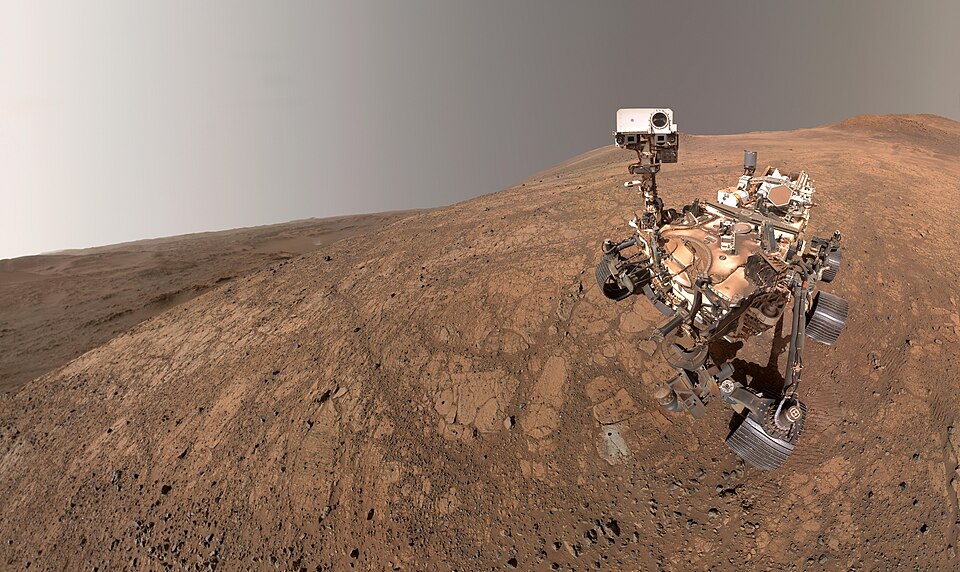

Since 1971, when English pop icon David Bowie first asked, “Is there life on Mars?” NASA has successfully landed 5 rovers on the Red Planet. Of these, the Curiosity rover touched down at Gale Crater in 2012, where it discovered rocks formed by a shallow lake around 3,600 million years ago, suggesting the environment was once habitable. Curiosity was joined in 2021 by the Perseverance rover, which is exploring Jezero Crater, a 3,700-million-year-old lake bed, for signs of past life.
Both Curiosity and Perseverance have discovered evidence of complex carbon-bearing molecules in rocks from Martian lakes. All life on Earth is composed of the same organic molecules, so astrobiologists reason that similar carbon-containing molecules in these rocks could provide evidence of past life on Mars. However, organic molecules can also be formed by non-biological processes, like when gases and minerals interact at high temperatures. Therefore, scientists need more compelling evidence to conclusively identify ancient Martian life.
Researchers from the Centro de Astrobiología in Madrid, Spain, recently tested whether DNA could serve as a biomarker in Martian rocks. They argued that DNA is the “most definitive biomolecule for life,” since it’s used by all life on Earth and, as far as we know, can only be formed by life. In addition, several factors that cause DNA to rapidly degrade on Earth, like water, heat, and microbes, are currently absent in the cold, dry Martian climate.
The biggest hurdle in finding ancient DNA on Mars is that its surface is constantly being bombarded by intense cosmic and solar radiation, which can rapidly degrade DNA and other organic molecules. Scientists in the past have shown that DNA has a better chance of surviving radiation damage if it’s shielded within rocks. So, this team wanted to test whether Mars-like rocks could protect DNA from radiation levels equivalent to about 100 million years on the Martian surface.
Scientists won’t have direct access to Martian lake rocks until future sample return missions, like NASA/ESA’s Mars Sample Return or China’s Tianwen-3 mission, occur. Therefore, the team sampled rocks of various ages that formed in lake or shallow marine environments on Earth. They targeted rocks that contained relics of ancient microbial communities, known as microbialites, and had total organic carbon concentrations similar to those measured in Martian rocks. These included a 2,800-year-old lake microbialite from Mexico, a 541-million-year-old shallow marine microbialite from Morocco, and a 2,930-million-year-old iron-rich rock from Ontario, Canada, which contained minerals similar to those found at Jezero Crater on Mars.
They crushed the rocks and split them into 6 samples each, which they sealed in glass vials. They exposed 3 samples from each set to radiation levels equivalent to 136 million years on the Martian surface, and left the other 3 samples unexposed, for comparison. They extracted DNA from each sample and analyzed it using a technology that can identify short fragments of DNA with high levels of confidence, known as nanopore sequencing. This method also generates a quality score for each DNA fragment, based on the probability that a specific DNA sequence is correct.
The researchers found that non-irradiated samples with more organic carbon also contained more DNA fragments. They explained that the DNA came from present-day microbial communities that recently inhabited the rocks, while the organic carbon came from long-dead microbialites. Therefore, they took this trend to mean that the modern microbes were feeding on the ancient ones – the more food available, the more microbes could grow. This result also supported the notion that locations rich in organic carbon, like ancient crater lakes, are prime candidates for life detection missions.
In the irradiated samples, the team found that radiation exposure decreased the DNA quality and fragmented it. For example, DNA from irradiated samples of the Mexican lake microbialite had quality scores on average 53% lower than non-irradiated samples, and DNA reads on average 85% shorter. But despite this extensive degradation, the team was still able to establish which microbes contributed about 2% to 9% of the DNA from irradiated samples!
The researchers concluded that identifiable DNA fragments could persist in Mars rocks for over 100 million years. They suggested scientists implement this highly sensitive sequencing approach on future Mars rovers to detect evidence of past life and assess planetary biosafety. While this result is encouraging for astrobiologists, it does come with caveats. Martian rocks often contain toxic salts that can further destroy DNA. In addition, scientists remain concerned about contamination from Earth-based life. The team recommended that future scientists develop stringent protocols to remove salts from Martian rock samples and assess external contamination.

