
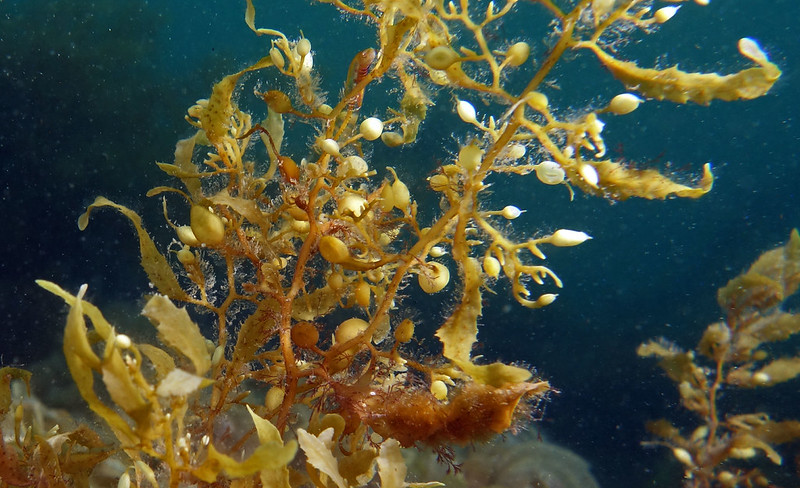

If you’ve ever swum in the ocean and been touched by seaweed, there’s a good chance it was Sargassum! This free-floating seaweed can have population explosions in coastal waters, degrading water quality, ecosystems, fisheries, and tourism. However, despite its drawbacks, scientists think that Sargassum could be useful for extracting valuable metals, known as rare earth elements (REEs).
REEs are classified by their average masses and atomic weights. Light REEs include cerium, praseodymium, and neodymium, middle REEs include gadolinium, terbium, and dysprosium, and heavy REEs include erbium, thulium, and ytterbium. These metals are used in magnets, electronic motors, wind turbines, spacecraft, and more. Our current methods of extracting REEs, open-pit mining and chemical processing, are invasive, causing habitat loss and producing toxic waste. Additionally, REEs are difficult to import due to restricted access worldwide. But what if these metals could be extracted using natural methods?
Scientists from Woods Hole and UCLA recently tested whether Sargassum could accumulate REEs, creating a sustainable solution to these problems. They harvested Sargassum at Waterfront Park in Woods Hole, rinsed the wet samples, and stored them in sterilized, filtered seawater, which they aerated with 12-hour cycles of light and dark to keep the Sargassum alive. They dried another set of samples in the sun under controlled outdoor conditions, stored them in sealed containers, and later rehydrated them in seawater for 3 hours before the experiments.
For each experiment, they added 5 grams (about 0.2 ounces) of Sargassum to solutions containing a mixture of 9 REEs – cerium, praseodymium, neodymium, gadolinium, terbium, dysprosium, erbium, thulium, and ytterbium – in concentrations totalling 0.1 micromolar (μM) REEs, 11μM REEs, 100 to 110μM REEs, and 575 to 600μM REEs. They performed each experiment 4 times: twice with fresh seaweed and twice with rehydrated seaweed.
The researchers removed 1 gram (about 0.04 ounces) of seaweed from each solution after 1, 3, and 7 days, and dissolved it in acid to release the REEs it had absorbed. They analyzed the concentrations of REEs in each seaweed sample and the leftover solutions using 2 different plasma-based methods. They used these REE concentrations to calculate the ratio of REEs in the Sargassum versus in the solution, known as the bioconcentration factor, to determine how effectively the seaweed absorbed REEs.
They found that after 7 days at lower REE concentrations (0.1μM), the fresh seaweed had bioconcentration factors of over 1,000. At higher REE concentrations (11μM), their bioconcentration factors ranged from about 400 to 700. However, these levels of REEs were eventually toxic to the fresh Sargassum, so they died after 2 weeks. In addition, the higher REE concentrations of 100 to 600μM were immediately toxic to the fresh Sargassum, which died within 1 day in solution.
The researchers determined that once the seaweed died, it could no longer actively take up REEs into its tissues but could only accumulate them on its surface or adsorb them. Adsorption can be thought of as a powdered donut – when the surface is covered with powdered sugar, no more powder fits on the donut. Similarly, there was a limit to how many REEs could stick to the Sargassum. Due to this limit, the fresh seaweed samples had bioconcentration factors below 250 in the highest REE concentrations. In contrast, the rehydrated Sargassum consumed less REEs at lower concentrations, but didn’t experience toxicity and continued to accumulate REEs at higher concentrations.
Finally, the team compared Sargassum to a common industrial method of accumulating REEs, known as activated carbon. REEs bond easily to activated carbon because of its abundant surface area and high porosity. Both materials accumulated a similar amount of REEs in solutions of 0.1μM REEs. However, at 575 to 600μM REEs, Sargassum accumulated about twice as many REEs as activated carbon, especially the heavier REEs.
The researchers concluded that Sargassum is a natural hyper-accumulator, meaning it successfully concentrates REEs. However, they recommended that future researchers test whether Sargassum performs the same in the natural environment as it does in the lab. If so, Sargassum could be used to accumulate REEs from wastewater, like mine drainage, or other water sources with higher concentrations of REEs. Regardless, they suggested that using Sargassum to obtain REEs could simultaneously expand global access to these metals and mitigate toxic blooms.
