

Radio signals are a staple of the first-contact subgenre of science fiction. Carl Sagan’s Contact famously revolves around the discovery of encoded radio signals from the star Vega, Liu Cixin’s The Three-Body Problem follows what happens after a scientist secretly makes radio contact with aliens, and Vince Gilligan’s Pluribus centers on what happens after scientists follow instructions communicated to Earth via radio signals. But how likely is it that we could actually receive an alien radio signal, or that aliens could receive an outgoing signal from Earth?
Scientists at Pennsylvania State University and the California Institute of Technology recently investigated this question. They identified radio signals as especially relevant to the search for intelligent alien life because astronomers know that intelligent species, humans in our case, can build machines that produce them and devices that detect them.
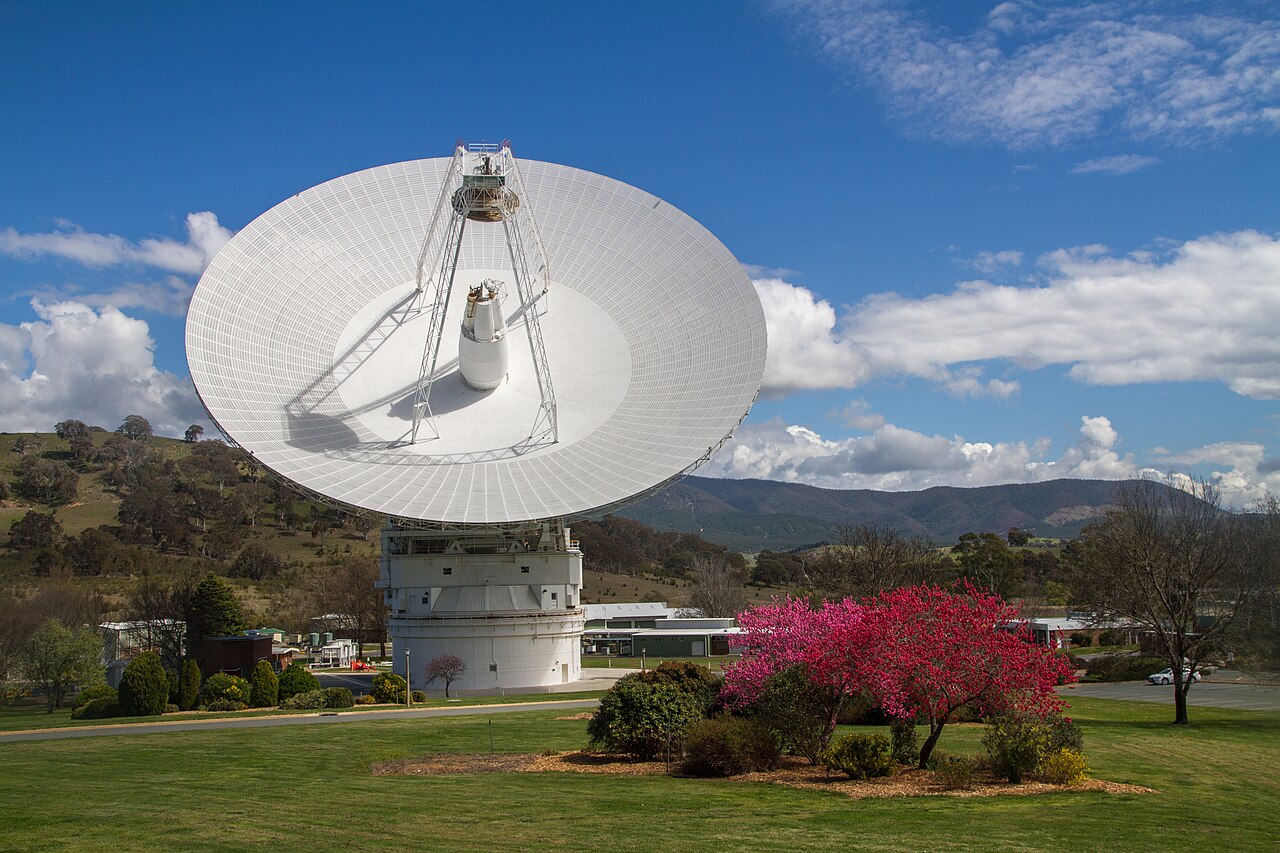
The team was particularly interested in a subset of radio transmissions from Earth that relay signals between ground stations and spacecraft far from Earth. This system, known as NASA’s Deep-Space Network, or DSN, comprises 3 sites in the United States, Spain, and Australia, each equipped with 70-meter (230-foot) and 34-meter (112-foot) radio antennas.
The distance at which signals from these antennas can be detected depends on how powerful the signal is, how long the would-be detector is observing the signal, the bandwidth they’re observing it with, and how distinct from background noise the signal needs to be. The team used a mathematical equation to calculate this distance, using the typical input power for a DSN signal and assuming that an extraterrestrial intelligence’s telescope for detecting signals from Earth would have similar specifications to the Green Bank Telescope, with 30-minute observation times. Using these parameters, they estimated that aliens could detect radio signals in a radius around Earth of approximately 7 parsecs. That’s 200 trillion kilometers or 100 trillion miles, which is only about 0.02% of the Milky Way’s diameter.
Next, the astronomers asked 2 related questions, the first of which would provide insights into the second. They asked: From which directions in the sky would Earth be most detectable by its radio signals? And, in which directions are the planetary systems from which Earth would most likely detect extraterrestrial radio signals?
To answer the first question, the team identified the directions Earth is sending radio signals by analyzing patterns in the distribution of DSN signals from Earth to satellites and telescopes like JWST. If DSN patterns from Earth resemble anything like what an extraterrestrial intelligence might have, then knowing these patterns would tell astronomers where distant observers are most likely to detect them. They used publicly available DSN schedules to see where in the sky and for how long their antennas sent radio signals from Earth. They used this data to construct a sky map, showing the directions in which Earth’s signals were being broadcast.
They found that most of the radio signals sent from Earth come from the Advanced Composition Explorer, the Deep Space Climate Observatory, and the Solar and Heliospheric Observatory, and are traveling close to the apparent path of the Sun across the sky, known as the ecliptic. They discovered that up to 79% of Earth’s deep-space radio transmissions were within 5° of the ecliptic, with prominent but weaker peaks in the directions of Mars, Mercury, Jupiter, Saturn, and JWST.
The researchers argued that if human civilization and its radio signals serve as a model for what to look for, then these findings have several implications. First, astronomers should prioritize searching for radio signals from distant planetary systems in which exoplanets pass between Earth and their host star. This is so that Earth-based observers could catch any stray signals an extraterrestrial civilization is sending to its own satellites and probes near its equivalent of the ecliptic.
Second, astronomers should prioritize searching during times when exoplanets around a host star pass behind each other. This is because when Earth passes behind a planet in the solar system that we’re sending radio signals to, the likelihood of a distant observer detecting these signals increases to 12%. So, if an extraterrestrial civilization is sending radio signals to its equivalent of Jupiter or Mars, Earth’s astronomers would have a better chance of spotting them.
Third, because most of Earth’s deep-space radio signals are concentrated near the ecliptic, astronomers should prioritize looking for radio signals in stars close to the ecliptic. Those stars are the most likely to have received radio signals coming from Earth and may be trying to reply. Following this model, they identified 128 star systems within a 7-parsec radius of Earth as possible places where aliens with human-civilization-level intelligence could detect Earth via its DSN transmissions, and vice versa. So, to have the best chance of finding Vegans, Trisolarans, or an alien hivemind, it may be best to look along the path of the Sun!

