
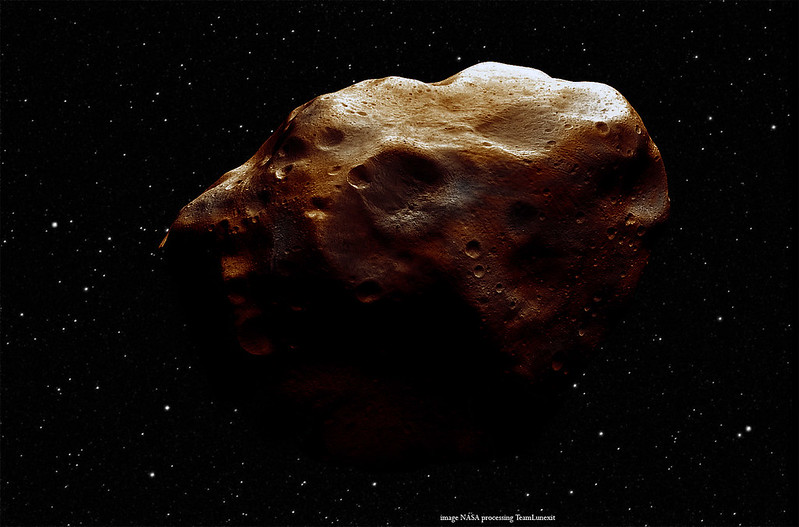

Scientists interested in the history of the solar system study the population of comets and asteroids with stable orbits around the Sun, located near Earth, known as near-Earth objects or NEOs. These NEOs potentially provided water and organic materials to the inner solar system, and they continue to crash land on the inner solar system planets, Mars, Earth, Venus, and Mercury, to this day. Their proximity to Earth also makes them easy to find and observe through smaller telescopes and easy to intercept, or potentially deflect, with probes and landers.
An international team of scientists recently released the results of a survey that identified and classified 39 new NEOs between February 2021 and September 2024. They used 2 telescopes for this work, including the 1-meter telescope at the Observatorio Astronômico do Sertão de Itaparica (OASI) in Brazil and the 2.15-meter Jorge Sahade Telescope at the Complejo Astronómico El Leoncito (CASLEO) in Argentina.
The team used these telescopes to observe how the NEOs brightened and dimmed over time. The NEOs they studied were all asteroids, which are basically clumps of ice and/or rock, so they don’t emit their own light. Instead, they only reflect sunlight. So, how bright or dim they appear from Earth at a given time depends on the angle they make with the Earth and Sun, their size, their shape, and their structure. By finding regular intervals over which the brightness of these NEOs dipped and rose again, the scientists could then calculate their rotational periods.
They found that the diameters of the 39 objects ranged from 0.1 to 10 kilometers, that’s 0.06 to 6 miles, with the majority between 0.5 and 3 kilometers, or 0.3 and 2 miles. The NEOs had a variety of shapes, ranging from nearly perfect spheres to elongated cigar-like bodies. The team also determined the rotational periods of 26 of these NEOs. The shortest took a little over 2 hours to make a complete rotation, while the longest took nearly 20 hours. Of these, 16 took less than 5 hours to make a complete rotation, indicating that many of the NEOs they sampled were relatively fast-rotating objects.
The researchers explained that a 2.2-hour rotational period marks the upper threshold for small NEOs known as rubble-pile asteroids, which are loose clumps of material held together by self-gravity. At that speed or faster, rubble-pile asteroids would be rotating so fast that centrifugal forces start to blow them apart. However, the smallest NEOs – 250 meters (820 feet) or shorter – can survive these fast rotations as long as they are one continuous chunk of material, known as monoliths. This team found small and medium-sized objects with relatively fast rotational periods, suggesting they have varied structures and formed in different ways.
The team also determined the chemical composition of 34 of these NEOs by taking images of the asteroids through a series of telescope lenses that only let in certain wavelengths of light, known as filters. The 4 filters they used selected for the colors green and red, plus 2 near-infrared wavelengths. They found that 50% of the NEOs were silica-based, like many Earth rocks, while 23.5% consisted of carbonaceous material, around 9% were composed of metals, another 9% were a combination of carbon and silicates, about 6% were basaltic material, and the remaining 3% were composed of calcium and aluminum.
While their chemical analysis of the asteroids mostly matched previous work in the field, they found no evidence of the mineral olivine, which is common in the smallest asteroids. However, this result can be explained by the fact that the vast majority of the NEOs they sampled were longer than the 200-meter or 660-foot maximum threshold for small olivine-rich asteroids.
The team’s work expanded the number of NEOs with known physical and chemical properties. They suggested that their integrated approach, combining techniques and observations from different telescopes, is an effective way to characterize small objects. They recommended that future researchers take several paths to follow up on this work. One is to closely monitor asteroids near the spin threshold for a longer period. Another is to observe NEOs with radar, which could detect whether any asteroids are actually binary pairs. And finally, teams could clarify the surface chemical composition of the asteroids by further analyzing their reflected visible and near-infrared light.
