

Space is empty. When one looks away from Earth or the Milky Way Galaxy and focuses on the space between galaxies, one finds that, on average, there’s only 1 atom for every cubic meter or 35 cubic feet of space. But space isn’t totally empty, and on those smaller scales, one can find quite a lot.
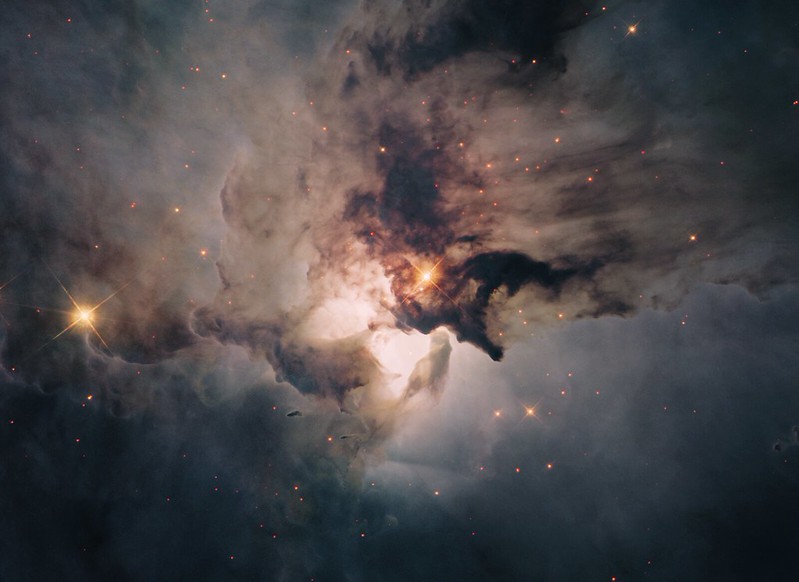
Within galaxies, there are collections of material between stars that exist in various phases of temperature and density, called the multiphase interstellar medium or ISM. Most of this material is made of the 2 lightest elements, hydrogen and helium, with a small amount of all the other heavier elements, which astronomers refer to generally as metals. It is also this material between stars that creates more stars.
A team of astronomers recently investigated how the presence or absence of metals, a quantity called metallicity, impacts star-forming regions of the ISM. They did so by simulating ISM clouds with metallicities matching 7 different regions of nearby space: the immediate region around the Sun, called the solar neighborhood, a random patch of the Milky Way, the Large and Small Magellanic Clouds, the dwarf galaxy Sextans A, the globular cluster NGC1904, and the blue compact dwarf galaxy I Zwicky 18. The team’s simulations are part of the Simulating the Life-Cycle of molecular Clouds (SILCC) project, a collaboration among several European research institutions that use high-powered computers to study the lifecycles of star-forming clouds of gas.
The team used a simulation code that modeled how gas moves in space and influences magnetic fields. The simulation’s structure was that of an enormous rectangular prism measuring 500 parsecs by 500 parsecs by 4 kiloparsecs. In other words, that’s a box measuring 15 quadrillion kilometers by 15 quadrillion kilometers by 120 quadrillion kilometers, or 10 quadrillion miles by 10 quadrillion miles by 77 quadrillion miles! Inside this box were gas molecules, bound together by self-gravity as a cloud, gravity from star clusters inside the cloud and old stars distributed through the cloud, and an external distribution of dark matter. To prevent the cloud from collapsing in on itself at the beginning of the simulation, the team coded the gas molecules to move at an average speed of 10 kilometers per second, or approximately 22,000 miles per hour, during the first 20 million years, essentially stirring the cloud.
The simulation modeled how the magnetic fields and fluids of the clouds moved after the starting period, how fast-moving, high-energy protons called cosmic rays interacted with the clouds, the formation, life, and death of stars within the clouds, and the chemistry of the remaining and resulting molecules over 200 million years. With all these factors accounted for in the simulation, the team isolated the impact of metallicity in each of the 7 simulations. The simulation representing the solar neighborhood had the highest metallicity, while the simulation representing I Zwicky 18 had the lowest, with only 2% the metallicity of the solar neighborhood.
They found that regions of the ISM with lower metallicity were, on average, warmer than those with higher metallicity. Their results showed that metals are much better at radiating away heat than hydrogen or helium. Cold phases of the ISM produced stars, which formed metals, while warmer, lower-metallicity regions tended to produce fewer stars, which further prevented them from cooling. This trend held up until the materials reached temperatures of around 1 million Kelvin, which is about 1 million °C or 2 million °F.
The team qualified their results by noting that they made several simplifications. For one, many parameters in their code could be adjusted to model ISM clouds, and, for the sake of time, they could only vary the metallicity in each simulation, even though the corresponding regions of space differ across other parameters. They also undercounted some more common metals, such as carbon, oxygen, and silicon, which are formed through nuclear fusion in stars at higher rates than other metals. And finally, they assumed that all massive stars ended their lives by exploding into supernovae, excluding the possibility that some of these stars would have formed black holes.
