
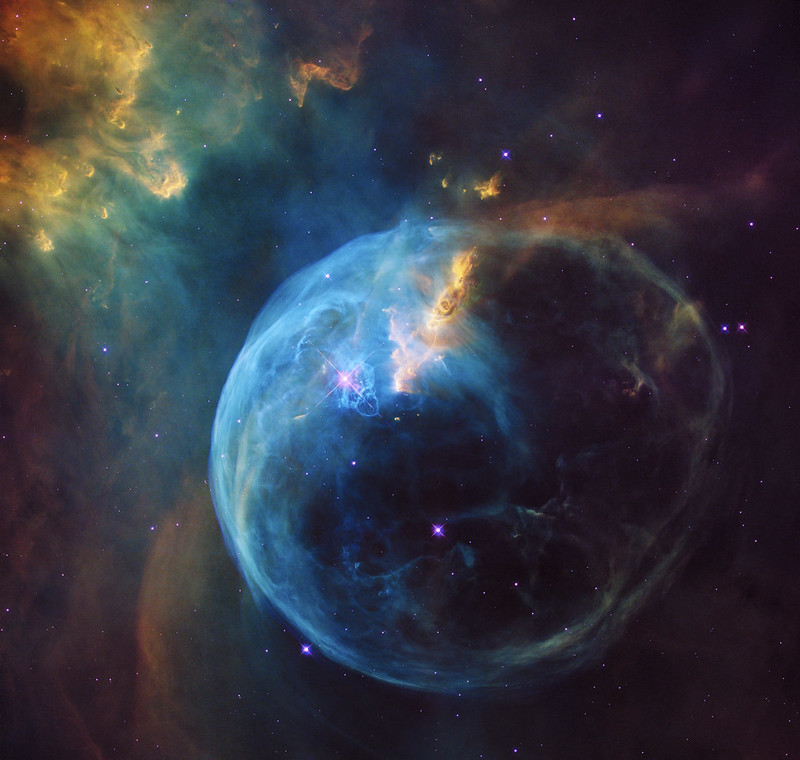

At the most fundamental level, a star exists when material is bound together strongly enough by gravity that it undergoes nuclear fusion at its center, but at the same time is not releasing enough energy to blow itself apart. The balance between inward-pulling gravity and outward-pushing pressure from radiation is known as hydrostatic equilibrium. The need for balance between these 2 factors imposes a limit on how big a star can be, known as the Eddington mass limit. The Eddington mass limit isn’t precisely known, but scientists think it’s likely somewhere between 150 and 300 times the Sun’s mass.
However, stars can stay together more easily if they spin. This is because a spinning object has a force pointing from its edge to its center, known as the centripetal force. This means that if a star spins, it experiences an additional centripetal force that points inward, alongside gravity, and counteracts radiation pressure. Knowing this, a team of scientists recently tested how the lives of massive rotating stars would be impacted by their spinning over the universe’s history. The fates of these stars could shed further insight into how the universe took shape, since massive stars create several prominent features of the cosmos, including black holes and supernovae.
The team made use of a grid-based modeling software known as the Geneva stellar evolution code, or GENEC. They used this code to model the behavior and long-term evolution of stars based on their initial characteristics. GENEC simulates stars as composed of multiple layers, then calculates the movement of material between these layers and out into space over time.
Two of the initial characteristics they varied in the model were whether the star spins or not and the star’s initial mass, ranging from 9 to 500 times the mass of the Sun. They stated that the behavior of very massive stars larger than 100 times the mass of the Sun would be inherently unstable and uncertain based on scientists’ current understanding. To address this, the team checked their results for very massive stars using 2 other models.
To test how the fates of massive spinning stars have changed over time, the team also varied the fraction of the star composed of elements heavier than hydrogen and helium, known as its metallicity. They claimed that metallicity could be used as a stand-in for how stars have changed over time, since the early universe, just after the Big Bang, would’ve had almost no metals, whereas the modern universe would’ve had considerably more metals. Therefore, if they studied what happens to a spinning star with almost no metals, they could see what the life of a spinning star that existed at the beginning of the universe was like.
After running the GENEC models, the team found distinct differences in the afterlives of stars that spun during their lives versus those that didn’t. They found that spinning massive stars were more likely to collapse into a black hole, and less likely to explode in a massive supernova or to collapse into a tight ball of neutrons, known as a neutron star. The researchers also found that very massive, non-rotating stars with low metallicity exploded in supernovae, while those with high metallicity collapsed into black holes.
The team suggested that the reason for this complicated relationship is that a spinning star causes its material to get more mixed up than a stationary one, which likely increases how much matter is available for fusion in the core. However, this spinning also means that the star sheds more outer material, which eventually decreases how much matter is available for fusion in the core.
Another factor that makes real stars more complicated is that most massive stars occur in multiples, specifically in close binary systems. Under these conditions, stars can exchange material, adding and subtracting mass from one another. The team suggests that the potential for real-life massive stars in binaries to lose mass before the end of their lives may cause their model to underrepresent how often massive stars turn into neutron stars at the end of their lives, rather than exploding or collapsing into black holes.
Overall, the team concluded that rotation has a complex effect on how stars evolve. While rotation makes some outcomes for a massive star more likely, such as collapsing into a black hole, the composition of the star and its initial mass also play large roles in determining its fate. And, while they acknowledged that the number of variables involved is large, they suggested that the next step in understanding the fates of massive stars is to explore those occurring in binary pairs.
