
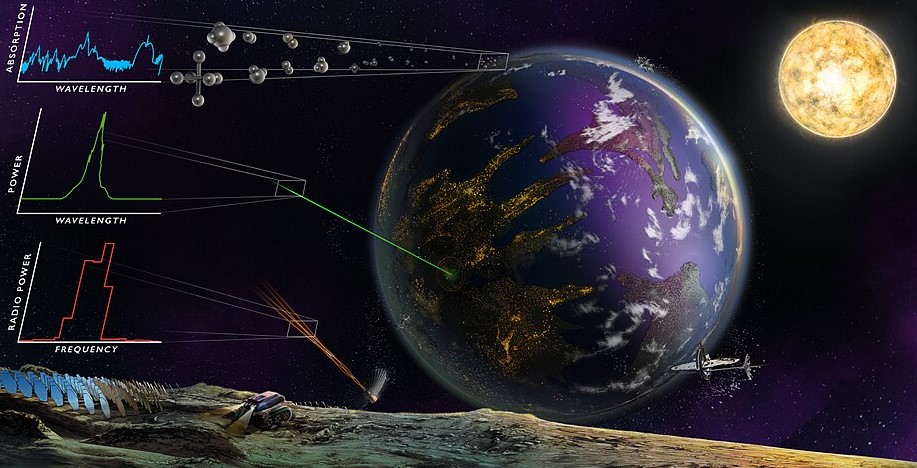

Humans have searched for signs of intelligent life beyond Earth for over a century. The most well-known effort, the Search for Extraterrestrial Intelligence (SETI), was popularized by Carl Sagan’s 1985 novel, Contact, and its later film adaptation. Like Sagan’s protagonist, many SETI researchers use telescopes to listen for radio signals from distant civilizations. But radio waves are only one way scientists search for alien life.
Astronomers sweep the skies for measurable signs of advanced technology, known as technosignatures. In 1906, astronomer Percival Lowell mapped what he believed to be a vast series of artificial “canals” on Mars. In 1960, physicist Freeman J. Dyson proposed that an advanced civilization might build a structure around its star to harvest energy, sometimes called a Dyson sphere. Lowell’s canals were natural erosion features, and Dyson spheres remain hypothetical, but the hunt for technosignatures persists.
Today, astronomers analyze the chemical fingerprints of distant planetary atmospheres to search for signs of life or advanced technology. Researchers have proposed looking for industrial gases, such as chlorofluorocarbons or hydrofluorocarbons, to detect alien civilizations on exoplanets. However, these gases are in Earth’s atmosphere at extremely low levels, which suggests that detecting them on an exoplanet would be challenging. Under ideal conditions, astronomers would need up to 500 hours of observation time on JWST, the largest telescope in space, to detect comparable concentrations.
Scientists led by Sara Seager at MIT proposed nitrogen trifluoride (NF3) and sulfur hexafluoride (SF6) as ideal technosignature gases. Both gases are produced by industries on Earth – NF3 is manufactured to clean semiconductors and solar panels, while SF6 is made to insulate transformers and other high-voltage electrical equipment – and their concentrations in the atmosphere have rapidly increased over the last few decades.
The team first ruled out biological sources of these gases, since living things could, ironically, produce a false positive for a technosignature. They searched a database of all chemicals made by Earth-based life and found that no known lifeform produces NF3 or SF6. In fact, no lifeform is known to produce molecules like these with nitrogen-fluorine or sulfur-fluorine bonds.
The researchers suggested that life on Earth might avoid using molecules based on fluorine because it’s locked in minerals and hard to remove. It also has unique chemical properties that make it difficult for biological machinery to handle. Namely, it attracts electrons more strongly than any other element, so it reacts intensely with other molecules and forms difficult-to-break bonds. They argued that these chemical traits would also make fluorine incompatible with extraterrestrial life.
Next, they considered whether these gases had any non-biological, or abiotic, sources, like tectonics or other geologic processes. NF3 has no known abiotic sources on Earth, but volcanism produces minor amounts of SF6. They suggested that any volcanism that produced SF6 would also release the more common volcanic gas silicon tetrafluoride (SiF4), such that astronomers could simultaneously observe SiF4 and SF6 to identify a volcanic source. If they found SF6 without SiF4 on an exoplanet, it would strengthen the case for a technosignature.
Finally, the scientists considered how easily these gases could be distinguished from other atmospheric gases on exoplanets. To “see” an exoplanet’s atmosphere, astronomers watch it move in front of its star and measure the wavelengths of light that pass through it. These data produce patterns known as transmission spectra. Ideally, each bump on the spectra would represent a single atmospheric gas, but in reality, some overlap or block each other, making them difficult to distinguish.
The team used the computer model Simulated Exoplanet Atmosphere Spectra (SEAS) to generate transmission spectra for a rocky exoplanet about 5 times Earth’s mass, known as a Super Earth, orbiting an M-dwarf star. They simulated spectra for 3 different atmospheres: one dominated by H2, one by N2, and one by CO2. They found that NF3 and SF6 both had spectral features that were distinguishable from those of the major atmospheric gases and theoretically detectable by JWST, albeit at levels much higher than current atmospheric levels on Earth. Next-generation telescopes, like the Habitable Worlds Observatory and Large Interferometer for Exoplanets, will be better suited to detect these.
Seager and her colleagues concluded that NF3 and SF6 are promising technosignature gases, but many uncertainties remain. Scientists have a limited understanding of how these gases behave in Earth’s atmosphere. In addition, their transmission spectra overlapped with those of chlorofluorocarbon gases, requiring additional research to untangle the signals. They also noted that it’s impossible to predict the waste products extraterrestrial biology might produce. But if astronomers observed a rapid, steady increase in technosignature gases on an exoplanet over about 100 years, it might be the clearest mark of an alien civilization becoming industrialized. Astronomers just have to get lucky enough to observe it!

